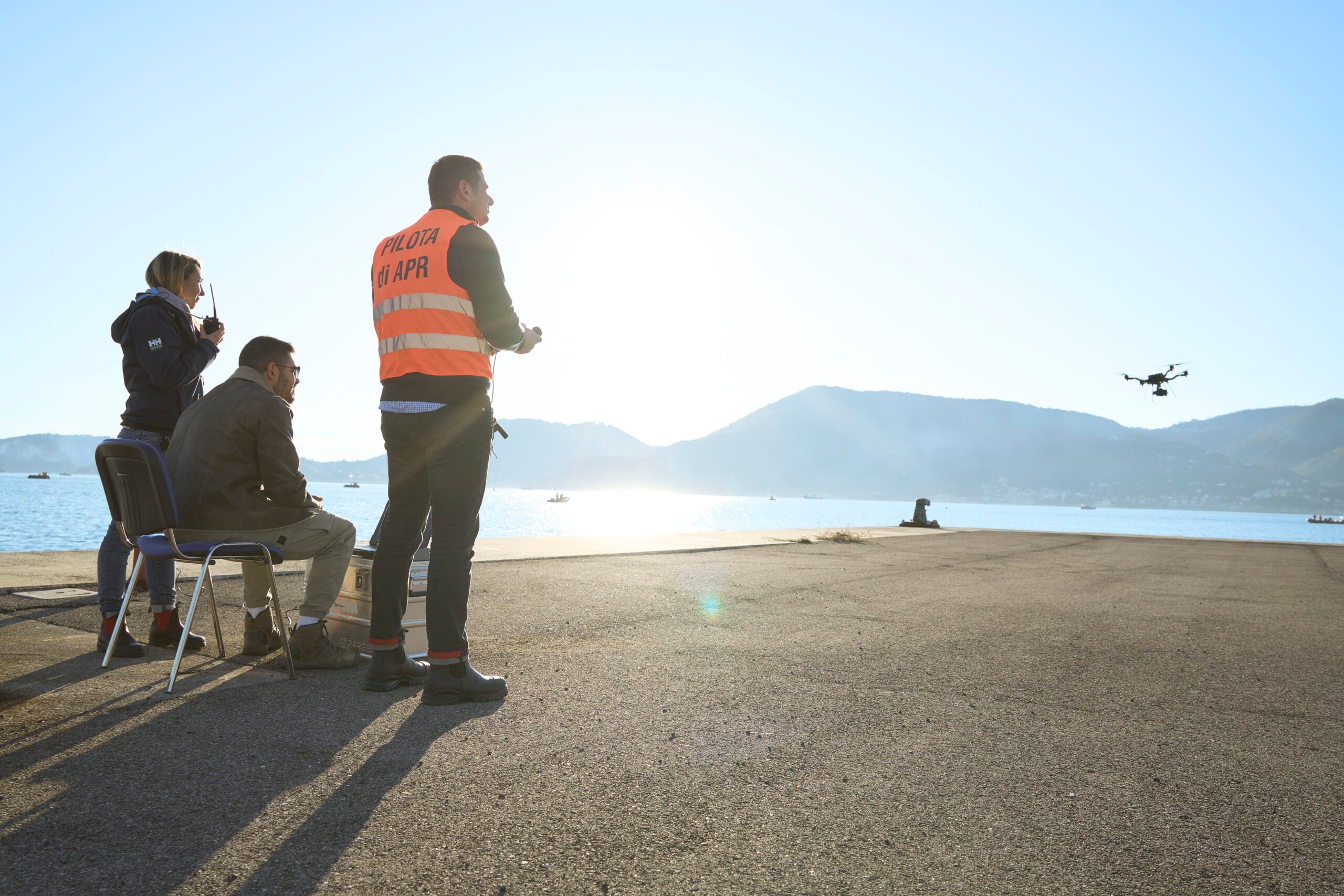
 Scientists at NATO’s Centre for Maritime Research and Experimentation (CMRE) in La Spezia, Italy, are leading the way in using artificial intelligence to detect, classify, and track drifting mines – an increasing threat in the Black Sea and beyond.
During a recent ten-day trial, researcher Metin Pekkaptan and his team tested high-resolution cameras mounted on drones to capture images of test mines from multiple angles.
“The challenge is immense,” Pekkaptan explained. “At 100 metres in the air, a mine appears as just a tiny black dot – only a few pixels. On top of that, we have to contend with sea reflections, temperature changes, and different lighting conditions. It’s an incredibly complex problem, which is why AI is so important.”
The team gathered about 50GB of data in a single day. This large dataset is now being used to train AI models, reducing the need for human involvement in detecting mines.
Drifting mines – unanchored naval explosives carried by ocean currents – are notoriously difficult to track and neutralise. Unlike seabed mines, they move unpredictably, posing serious risks to both military and commercial vessels. In conflict zones like the Black Sea, rogue states have deployed them illegally to disrupt trade and threaten maritime security.
Traditional mine detection relied on human operators scanning screens without software assistance. Pixel-based methods improved this by using mathematical analysis, but AI is now revolutionising the process. “Instead of telling a computer exactly how to spot a mine, we let AI learn from the data itself,” said Pekkaptan. “This makes detection faster, more accurate, and more adaptable – especially when dealing with objects that are barely visible in aerial images.”
The next step is combining infrared imagery with optical data. “Infrared cameras can pick up heat signatures from a mine’s metal casing, making it easier to detect mines under different conditions,” Pekkaptan added.
NATO allies, particularly Turkey and Romania, are closely following the project due to its strategic importance for key waterways like the Bosporus. This AI-powered technology has uses beyond spotting mines. It could help with border security, tracking illegal ship movements, and other maritime challenges.
“The potential is huge,” Pekkaptan concluded. “It’s exciting to be part of such groundbreaking research.”
